Ready to put your business in motion? Review current 602Ads campaigns and book your advertisement, or ask about your proposed area and dates.
Outdoor advertising agencies in Phoenix help businesses think about visibility beyond a single sign. The challenge is choosing a mix of media that introduces the right message in appropriate settings without spreading the budget too thin. A billboard, transit display, street-level advertisement, and moving bicycle billboard may each play a different role. The useful question is how those roles support your business objective.
This article focuses on planning the media mix. It is different from selecting a billboard agency or reviewing one lease. You are deciding what a campaign should do across formats, which pieces deserve funding, and how the customer journey will remain clear when someone encounters the message in more than one place.
Start with a customer journey you can describe
Think about how someone could move from noticing your business to taking a useful next step. A potential customer may encounter a name outside, search later, compare an offer, and finally visit or request information. That sequence is only a planning model, not proof that every customer behaves the same way.
Write down the task of each campaign element. One placement might introduce the business, while the website explains details and the store completes the sale. If two media elements do exactly the same job without adding useful coverage, reconsider the allocation. A larger collection of formats does not automatically create a stronger plan.
Map the geographic task before choosing the format
Define where the business can realistically serve customers. A neighborhood shop, a mobile service, and a regional attraction have different geographic needs. Start with actual locations and service boundaries rather than a general desire to reach everyone in Phoenix. Broad exposure can be wasteful when the offer is useful only within a small area.
Then discuss proposed coverage with the provider. Confirm which locations, routes, and operating periods are available. A planning map should distinguish confirmed placements from ideas still being explored. Do not build a launch announcement around a location that has not been secured or a route that has not been assessed for practical operation.
Understand the role of fixed billboard placements
A fixed billboard can connect a message with a specific location and viewing direction. When reviewing a proposal, ask about the unit, dates, approach, visibility, and production requirements. Consider whether the message makes sense for people who can actually encounter that face. Nearby traffic on a map does not establish that everyone has a useful view.
The creative should fit the setting. An introduction that can be understood quickly may work differently from an advertisement that depends on reading detailed conditions. Use the sign to communicate the essential message and let a suitable destination carry the explanation. Avoid forcing the whole customer journey onto the billboard.
Give digital displays a defined purpose
A digital proposal may offer scheduled appearances within a rotation rather than continuous exclusive display. Ask what the purchased schedule includes and how delivery will be documented. If timing matters to your offer, confirm the actual scheduling options instead of assuming the campaign can run whenever you imagine.
Plan your local campaign. Compare 602Ads campaign options and book online.
Digital flexibility can be useful when a message changes, but frequent changes still need management and review. Assign responsibility for creative versions and expiration dates. A technically flexible format becomes confusing when the wrong offer remains active or the destination page does not match the version people are seeing.
Consider transit and other public-setting media separately
Transit advertising can place messages in travel-related environments, but proposals differ by vehicle, station, shelter, format, and arrangement. Ask what is actually included. A photograph of one attractive installation should not substitute for a clear description of the media your campaign will receive.
OUTFRONT’s Phoenix resource describes buses, light rail, freeway bulletins, and surface-street posters among its offerings. Lamar’s Phoenix resource also describes several outdoor formats. These provider descriptions establish that the local media landscape contains multiple products. They do not make every format available for every advertiser’s preferred dates or budget.
Decide what street-level moving media adds
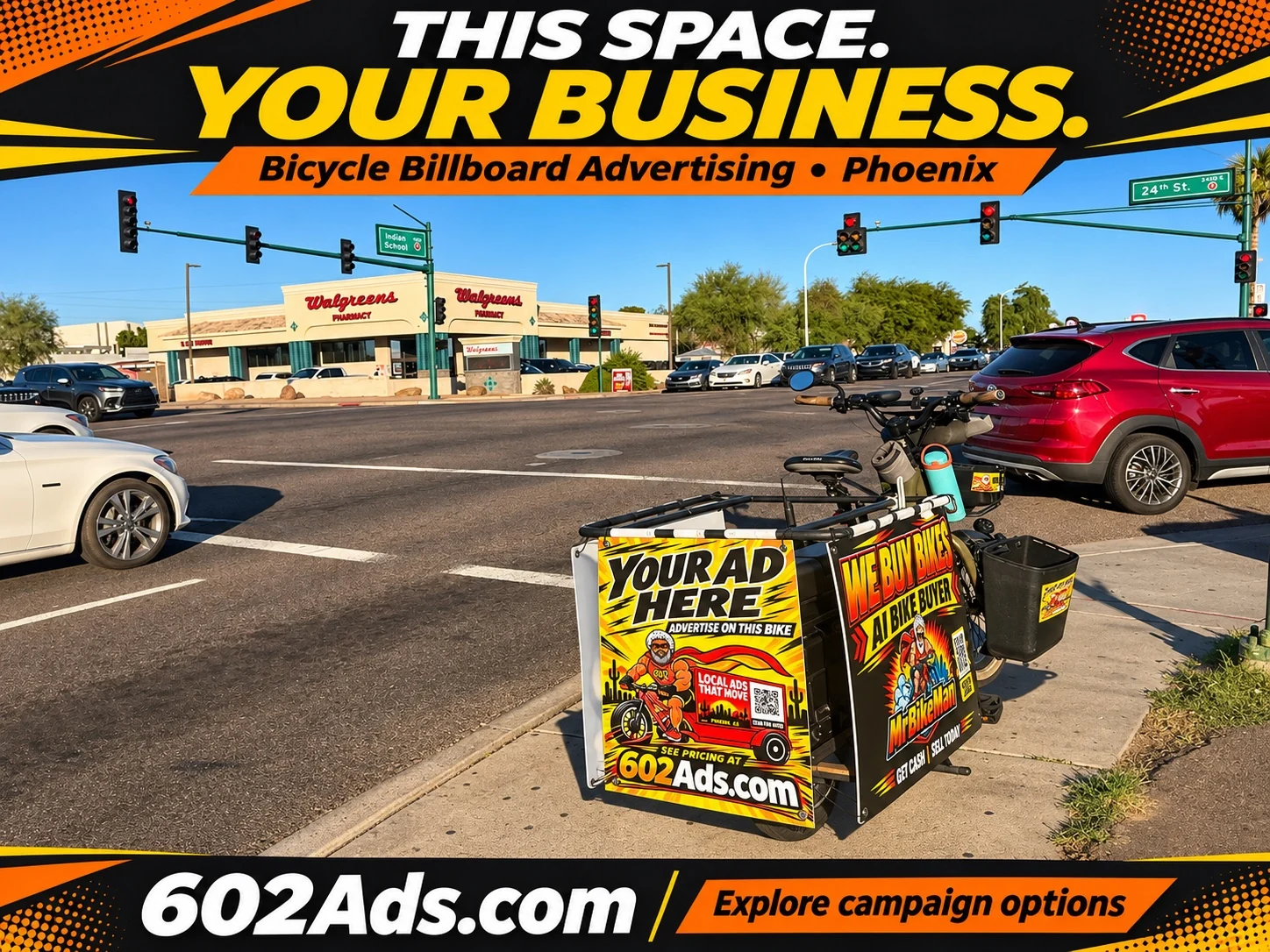
A bicycle billboard gives the campaign a moving, street-level format. Discuss the proposed setting, schedule, artwork, and documentation with 602Ads. The useful contribution may be focused local visibility, but that must be evaluated against the actual campaign scope rather than assumed from the format’s novelty.
Do not describe a bicycle campaign as a freeway replacement with equivalent reach. The operating context is different. Its message should suit the sign size and the circumstances in which people may see it. Ask what role it should play in the broader plan instead of treating every outdoor product as interchangeable.
Keep one identity across the media mix
People need a consistent connection between the different advertisements. Use the same business name, recognizable visual identity, and central offer where appropriate. Different dimensions may require different layouts, but the campaign should still feel like one business communicating a coherent message.
Consistency does not require identical copy everywhere. A brief outdoor introduction can lead to a more detailed page, while a nearby retail sign can clarify location. The shared idea matters more than mechanically reproducing every word. Create a simple reference sheet so everyone preparing creative understands the approved name, offer, destination, and dates.
Allocate budget according to roles and evidence
Fund the parts necessary for a complete campaign before adding more formats. That may include artwork preparation, a functional destination, media delivery, and a reporting process. A plan with fewer well-supported elements can be easier to operate than one that leaves every channel underfunded.
Request costs and scope for each component. If a combined proposal is too large, ask which element can be removed without undermining the main task. This creates a more meaningful discussion than asking for an unexplained discount. You are choosing the campaign’s structure, not merely bargaining over a final number.
Plan a launch sequence your team can maintain
Some campaigns need all elements to begin together; others can be introduced in stages. Decide which approach fits the objective and the available resources. A staged launch may help a small team verify the destination and intake process before increasing visibility, although it also changes how results should be interpreted.
Use a calendar with creative deadlines, approvals, production, launch, review, and offer expiration. Include the internal team that handles customers. Media can go live on time while the business remains unprepared to answer questions. A coordinated schedule connects the external campaign with the people responsible for serving the resulting interest.
Measure contribution without pretending attribution is perfect
When several formats run together, a customer may remember more than one. A campaign link can identify some visits, and an optional source question can add context. Neither method proves the full influence of every advertisement. Keep reporting definitions clear and acknowledge overlapping exposure.
Record actual business outcomes alongside delivery. Relevant requests, appointments, redemptions, or purchases are more useful than treating all attention as equivalent. If one format has better documentation than another, do not assume the documented format caused every result. Measurement quality and campaign effectiveness are related questions, but they are not identical.
An illustrative local opening campaign
Consider a fictional neighborhood store preparing an opening. It could start with a clear opening page and accurate hours, then discuss a focused outdoor introduction. A fixed placement, a suitable public-setting format, or a bicycle campaign might be considered depending on coverage and budget. None should be booked solely because it is visually impressive.
The store could use one recognizable opening message across the selected formats and keep the offer details on its page. Staff could record redemptions and ask customers how they heard about the business. This example illustrates coordinated planning; it is not a 602Ads case study or a prediction of results.
Questions that improve the agency conversation
Ask what each proposed format contributes, where overlap is intentional, and what happens if a component becomes unavailable. Request the assumptions behind the plan. If a recommendation depends on a specific event, audience, or schedule, ask how that dependency will be verified before the campaign launches.
Also ask who keeps the campaign coordinated after approval. Creative updates, reporting, and schedule changes need ownership. A strong media plan can still falter when no one maintains the connections between its pieces. Make coordination a defined responsibility rather than an informal expectation passed between vendors.
Turn the media plan into an actionable brief
Your final brief should identify the objective, audience opportunity, geographic focus, selected formats, message, destination, budget, and review method. Include confirmed details separately from open questions. That document helps an agency or operator propose a campaign you can assess and helps your team understand what it must support.
Outdoor advertising agencies in Phoenix are most useful when the assignment is clear enough to guide decisions. If a bicycle billboard belongs in your proposed mix, explore current 602Ads campaigns and discuss availability. Choose media for the role it can realistically perform, then keep the customer journey clear from first recognition through the next action.
Explore related Phoenix advertising guides
- Affordable Billboard Rental Phoenix
- Phoenix Billboard Advertising Agencies
- Billboard Space for Lease Phoenix
- Phoenix Out of Home Advertising
- Phoenix Billboard Sales Companies
Ready to put your business in motion? Review current 602Ads campaigns and book your advertisement, or ask about your proposed area and dates.
Research references: OUTFRONT Phoenix and Lamar Phoenix. Provider offerings were checked November 24, 2026. Current prices and availability require confirmation. No affiliation is implied.
Put your business in motion with 602Ads.
Book your ad