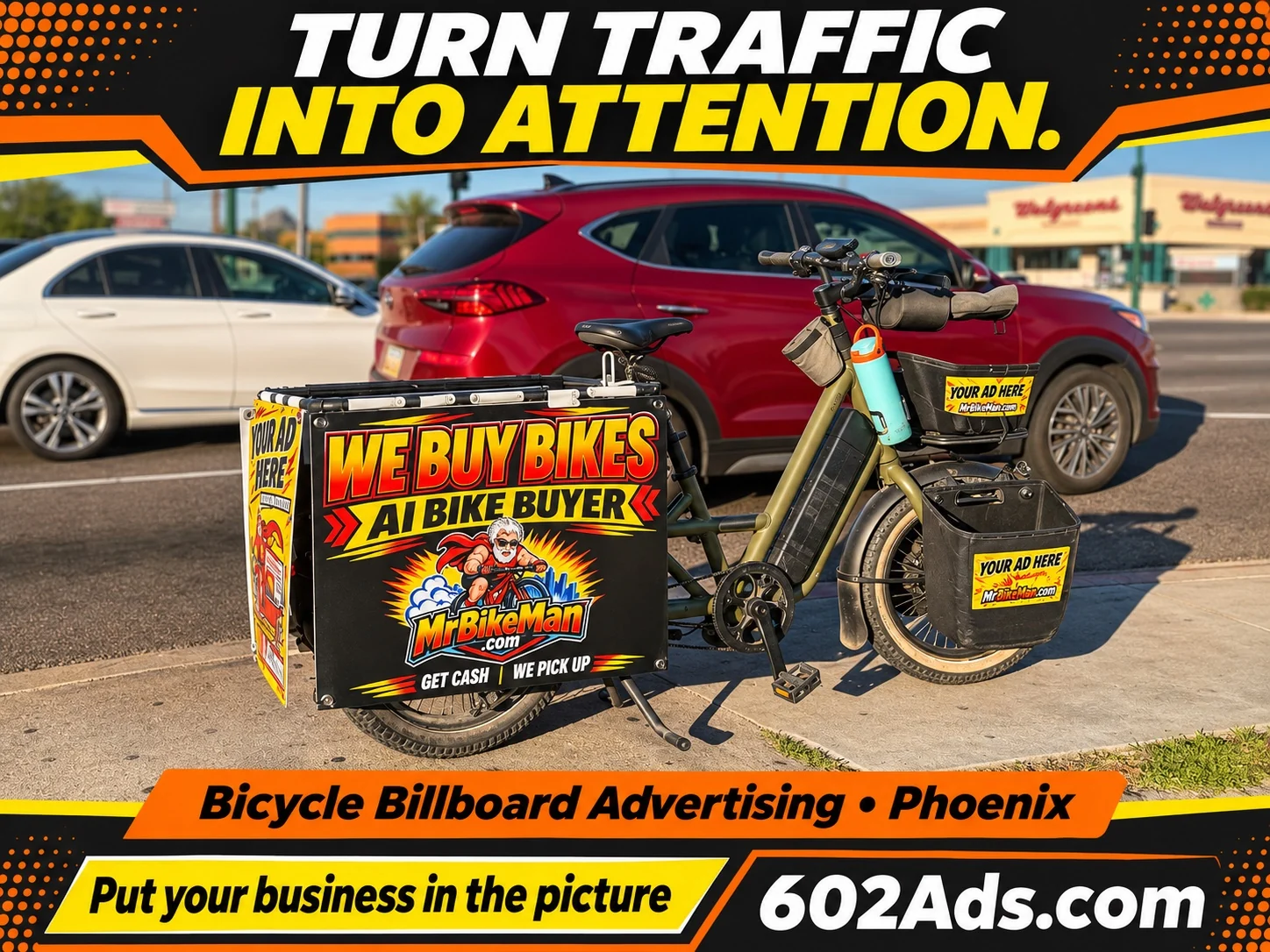
A busy Phoenix intersection looks promising in a photograph. Cars fill several lanes, a bicycle billboard is visible near the street, and the surrounding businesses establish a local setting. For a business owner considering advertising, the natural question is how many potential customers that activity represents. The answer requires more care than counting cars in the picture.
Traffic counts, billboard impressions, reach and inquiries describe different things. Understanding those differences helps you ask better questions before booking a campaign. This guide focuses on evaluating audience claims for Phoenix outdoor advertising, using a 602Ads bicycle billboard example to explain what a photograph can show and what requires separate evidence.
Start with what the supplied image actually shows
The example image shows a cargo bicycle carrying printed advertising near traffic. Its headline, “Turn Traffic Into Attention,” expresses the campaign idea: introduce a local business through a visible physical display. The picture helps a prospective advertiser understand the format, scale and setting. It does not establish the number of people who noticed the message.
Use photographs to assess the equipment and creative context. Ask separate questions about campaign dates, routes and reporting. Keeping those questions separate gives you a clearer purchase decision than assuming that a crowded photograph proves a particular audience size or number of customer responses.
Understand what a traffic count measures
A traffic count describes movement past a location during a defined period. The count might concern vehicles, pedestrians or another unit, depending on the source. Ask what was counted, where the count was taken and when the information was collected. A figure without those details is difficult to interpret.
A road’s full-day vehicle count is not automatically the audience for an advertisement displayed there for a shorter period. The relevant direction of travel, actual campaign hours and whether the sign was visible all matter when deciding how useful that traffic information is to your purchase.
Distinguish impressions from raw traffic
In its outdoor audience measurement explanation, Geopath describes circulation data as a foundation and visibility research as another step in estimating advertising impressions. This illustrates why traffic passing a location and an estimate of advertising exposure should not be treated as interchangeable figures.
Ask a provider which definition it uses. An audience estimate should come with an explanation of its method and scope. Mentioning an industry measurement organization does not prove that a particular display has been measured by that organization. Request evidence specific to the proposed inventory.
Ask whether the figure concerns people or vehicles
A vehicle is not a person, and one vehicle can contain more than one person. However, multiplying a vehicle count by an assumed occupancy number does not, by itself, prove that those people saw your sign. Visibility and the period of display still need consideration.
Keep the original unit in your notes. If a proposal starts with a vehicle count and later calls the same number customers, ask for clarification. This is a practical request for consistent terminology. A clear provider should be able to explain the evidence without changing what the number represents.
Match the reporting period to the actual campaign
Check whether each figure is hourly, daily, weekly or for the entire campaign. Then ask whether it reflects the schedule you are buying. A full-day road count and a campaign operating during selected hours describe different time periods, even if both concern the same street.
For a moving display, ask how the estimate accounts for time spent in different places. Do not simply multiply the daily traffic totals of every road on a proposed route. A bicycle passing through an area is not present for every vehicle counted there throughout the day.
Consider the viewing direction and physical setting
A sign can be present while facing away from part of the traffic. Other vehicles, street furniture or the viewing angle can also affect visibility. The supplied image helps demonstrate the display arrangement, but a single viewpoint does not describe every possible audience approach.
Ask how the provider plans the campaign around practical visibility. Keep safety and lawful access part of the operating plan. No advertising benefit justifies obstructing a sidewalk, entering a restricted area or treating a traffic signal as an invitation for drivers to interact with a phone.
Do not confuse impressions with unique reach
A person may encounter the same campaign more than once. In advertising measurement, reach concerns the distinct audience, while frequency concerns repeated exposure. An impression total should not automatically be described as that many different people. Geopath’s measurement glossary provides definitions for comparing common outdoor advertising terms.
When a proposal includes reach or frequency, ask how those measures were derived. If the provider does not measure unique audience, record that limitation. Repeated visibility may still fit your goal; the decision simply needs to reflect what is known rather than an unsupported unique-person claim.
Separate campaign delivery evidence from audience evidence
A dated photograph may document the appearance of your artwork during a campaign. Route information may document where an operation traveled. Those records answer useful delivery questions. They do not automatically tell you how many people noticed the advertisement or remembered the business afterward.
Before booking, ask exactly which records you will receive and what each record establishes. Our billboard quote comparison checklist can help organize those questions alongside production, coverage and campaign dates. A clearly defined service remains easier to evaluate even when no fixed impression total is available.
Compare audience claims on the same basis
Suppose one proposal provides modeled impressions for a particular fixed display and another provides operating dates, route coverage and photographs for a mobile campaign. These are different evidence packages. Do not compare the numbers as if both providers have measured the same thing through the same method.
Write down the objective each option supports and the limits of its reporting. A campaign can be worth considering because of its relevant local coverage without claiming a measured audience it does not have. Your task is to decide whether the documented offer fits the business purpose.
Use CPM only when its denominator is meaningful
Cost per thousand impressions divides a defined campaign cost by the impression total and multiplies the result by one thousand. The arithmetic can be correct while the comparison remains weak if the underlying audience figures use incompatible definitions. Ask what costs and what impressions are included.
If a provider cannot support an impression estimate, avoid inventing one to produce a convenient CPM. Compare the campaign’s scope, relevance and measurable responses instead. A precise-looking price per thousand is not helpful when the thousand itself comes from an unexplained assumption.
Connect visibility to a useful customer action
Decide what interested people should do after seeing the advertisement. A short website address can lead to service information, an appointment request or a relevant offer. Keep the action connected to the message. Someone should recognize that they reached the business and offer they noticed.
A useful response page also makes results easier to interpret. Our billboard landing page guide covers the connection between outdoor creative and the next customer step. Traffic estimates do not replace preparing that step before the campaign begins.
Track responses without overstating attribution
Use practical measures such as campaign-page visits, inquiry forms and a customer source question. Train the team to record responses consistently. Note what happens after the inquiry, including whether the lead fits your service and progresses to a completed appointment or purchase.
These records have limits. A person may notice a sign, search your company later and contact you through your usual website. Our mobile billboard ROI guide explains ways to review responses while recognizing that several marketing channels may contribute to the same customer journey.
Bring a short list of questions to the provider
Ask what is counted, the source, the date range, the covered locations and whether the method applies to your exact campaign. Ask which claims are estimates and which are directly documented. If there is no audience estimate, ask what delivery records and response tracking are available instead.
Keep the answers with the proposal so you can review results against the original promise. This is especially useful when several people in your business approve the purchase. Everybody should understand the same schedule, coverage and reporting arrangement before artwork goes into production.
Choose a Phoenix campaign with clear expectations
Before approving a purchase, write your objective in one sentence and identify the evidence you will review afterward. That small step helps prevent an attractive photograph or a large traffic figure from replacing the question that matters: whether the documented campaign fits the people, service and response process your business can support.
The supplied 602Ads image makes the bicycle billboard format easy to picture. The buying decision should then rest on an accurate description of the campaign, a relevant message and a workable response process. At 602Ads, fixed impression totals and specific numbers of leads or sales are not promised.
Ask about a 602Ads Phoenix bicycle billboard campaign with your intended area, business offer and preferred dates. Review the available coverage and reporting before booking. Clear expectations let you judge the campaign on what was actually agreed and what your own business records afterward.
Put your business in motion with 602Ads.
Book your ad